We have collected more than 100 brand new call girls number and added it to a pdf for easy sharing.
To download 100+ Dhakaia Magi's number, complete the captcha and download it.

Download now


Loading Captcha...

If it doesn't load, please disable Adblock!


Showing posts with label Web Tech. Show all posts

Feeding Search Engines To Rise in Rankings

Search Engine Optimization or SEO. While many businesses may have an idea of what it is, they may not understand how it works or, at least, how to make the most of it for their business. Every business wants to get to the 'top spot' in search engines like Google, Bing, Yahoo, etc. but to do that you have to first understand how SEO works.

Understanding Search Engines

Understanding how search engines work is critical when trying to improve the search ranking of businesses. Without this understanding it is primarily a guessing game and businesses need their SEO strategy to be based on knowledge, not a guess.
Crawling: To begin the process, search engines do what is referred to as Crawling, which does just what it sounds like - it crawls across all the information on the Internet and locates new or updated sites and information. Using Google as an example, they have an enormous set of computers that handles the search portion of their function which is called the Googlebot. By using those infamous Google algorithms, Googlebot "crawls" through all of the data across all of the Internet looking for sites, data and information that was not there previously.
Indexing: When Googlebot compiles all the new words, sites and information that it found during its "crawl", along with the pages where that information was found, it is called Indexing. It is during indexing that things like title tags are processed and compiled as well.
Serving Results: When someone goes onto Google, or any search engine for that matter, and enters keywords to conduct a search, the search engine will then locate all the pages that have the words that were entered into the search and pull out the pages and/or sites that are the most relevant to those keywords. The more relevant the page content is to the words in the search, the higher up in the results that page will be displayed, otherwise known as page ranking. This function also uses the predetermined algorithms as a part of its final determinations.
Now that you understand a little more about how a search engine crawls a business website, it is time to start working on creating a website that will appeal to the search engines.
When you take into consideration the mass of information that search engines are sifting through across the Internet it should make you realize even more why an effective search engine optimization (SEO) strategy and content strategy are so important.

What To Include In The SEO Strategy

  • Keyword Research - using words from the business's niche market as well as for the industry and target audience
  • Content that is optimized, client-focused and helpful, not just marketing-based
  • Optimized pages and posts

Start With Keyword Research

This is where strategy should begin. Find out what keywords customers and potential customers are going to input when they are looking for a business's product or service. Thankfully there are a number of things that can assist with this.

Online Keyword Research Tools

Social Media - see what people are talking about on social media about the business's niche.
The customer service and sales staff - they are on the front lines of any business and have the most direct interaction with customers. They can provide the questions customers are asking or items they are most looking for.
Customers - while the sales and customer service staff interact with customers daily, make a direct connection with them as well to find out their needs or any problems a business's product or service can solve.

Create Content That Readers Can Trust (And Feeds The Search Engines)

People go to businesses they can trust and that can help them. One way to create trust is by becoming a thought leader in the industry through creating content that is relevant to the reader and something they would actually search for on Google (Ex: How to SEO a blog post).

Content Ideas

  • Blogging on "how to" topics
  • Creating FAQs pages/posts
  • Resource pages for specific geographic areas
You'll want to make sure to use keywords within the content which should already be part of a business's local SEO strategy. Be sure to check any old posts on the site and ensure they have been optimized and, if not, change them.
To keep website visitors on the site, each page or post should also include at least one link to another page within your site to keep them moving throughout.
In addition to creating SEO focused content, it is also necessary to optimize title tags, image names and image descriptions. Even though these are not visible to website visitors, this information is important to search engines as the information is indexed as they crawl the site.
I realize that this seems like a lot to do, but remember, the search engines are crawling every piece of information on the Internet and a business needs to be optimized to stay relevant in search results.
The SEO strategies outlined here, when implemented, will increase site optimization, attract more visitors, and keep those visitors on a site longer. All of which is what is needed to move the rankings higher on search results.

How To Use Google Keyword Planner Tool For Keyword Research

Keyword research is one topic, which every blogger should learn from day one. Probably, every Blogging or SEO blog you have read till now, I’m sure Google Keyword planner (previously Keyword Tool) and “Keyword research” are not a new term for you.  But if not, you are missing out the basic of any Blog SEO.


Blogging has evolved from just quality content to SEO optimized social content. Writing quality content is must, but at the same time it’s good to have the properly optimized article to rank well in search engines. This is where, on page SEO comes into the picture. On the page, SEO starts with selecting the right keyword for your post, and the keyword should be one which have search volume. That means people are searching for that particular keyword.

Here is one question you should ask yourself: Even though I’m writing quality content, why I’m unable to drive enough traffic from search engine? Well, I’m sure Google doesn’t have anything against you until unless you are doing Black Hat SEO. The reason is, you are not writing on topics that people are searching for. Or even you are writing on a topic that is trending, but you making it hard for search engine bots to understand your content. I have already  covered how to write SEO optimized articles in WordPress, and today you will learn how to use Keyword planner tool for researching Keyword.
To start with; if you are not sure, why Keyword search before writing a blog post, you should read my post on Importance of Keyword in SEO.

What is Keyword research?

Lets get to know the basics first. In layman language, Keyword research is the process of identifying Keywords, which get the good amount of search volume/month. For example, Keyword: “KeywordSpy”, “Website SEO optimization tip” and so on.  The idea behind performing a research is to, find the keywords that can give maximum traffic and comes with less competition. I will discuss competition part later in this post. For example: When you do an exact match search:  “WordPress SEO plugins”, “Best WordPress Plugins for SEO ” both gives the entirely different picture in terms of traffic.
keyword traffic difference
By doing a complete Keyword search, you will be able to find keywords to drive targeted traffic, more revenue and more niche traffic. More over, when you are planning to target a small niche, for example “Bug Spray”, doing a Keyword search will help you to find many new Keywords that you might be missing out. You can also analyze competitor site and find keywords which they were ranking for. Doing a comprehensive Keyword research based on the data, can drive immense traffic to your site.  And by the end, the sale happens only when you are getting targeted traffic. Isn’t it?

What is Google Keyword Planner tool:

Google Keyword tool is an official product from Google, which gives us a traffic estimation of our target Keywords and also help in finding more relevant and related Keywords for your niche. Few Important things to know:
  • You need to have a Google Adwords account to use Google Keyword planner tool. It’s free, and you don’t need to spend any money to use this tool. You can simply create an Adwords tool and start using it.
  • You can also search for existing Google Adwords coupons to create one free account for yourself, and start using Keyword planner tool.
  • This tool is created to target Adwords advertisers, but it still give a great deal of information when it comes to finding the right keyword for your blog and articles.
This is what the homepage of Keyword planner tool looks like. All you need to do is enter your target Keyword that you want to start searching for. After that, you can add filters such as for which country you want to target your keywords (In below example, All location is selected).

Using Keyword planner tool
1) Enter your product or services:
This is the place where you will put your target Keywords. For example, my next post in on Keyword research, and I’m not sure what keyword I should be targeting that post for, I will do some searches based on my knowledge like you see in example, and it shows me results globally and local search.  The idea here is to find a Keyword that has good traffic but low competition. If you are working on a blog for the long-term goal, you can also target high competition Keyword, using resource pages. For ex: WordPress guide. It makes take time before you see your keyword ranking at the good position. Below image illustrates the difference between Broad search, Exact search and phrase search.
Broad Match Traffic
2) Search type:
This is one important column that you should be taking care of. There are three options for search type:
  • Broad
  • Exact
  • Phrase
Exact Match: Exact searches, shows the traffic for exact match Keyword. For example, if you search for WordPress SEO in exact match, it will be different from broad search in great way. My suggestion, prefer Exact search when you are doing research for your micro-niche site and broad search when you are writing on the personal blog. Ex: Keyword Research Broad Match: Broad Match is my favorite, as it let me target long-tail keyword, and your traffic is not limited to exact match words. For Bloggers, broad match is useful but that again depends upon your blog type and target. Ex: “Keyword-based research” Phrase: Phrase type is useful when you need Keyword in an exact phrase. For example: “Best Keyword Research”. Keyword position won’t be changing, but it gives the data for traffic, that your Keyword might be getting for phrase search.
3) Advanced option and filter:
This feature is set to add more filters into your search. For example Country search volume, Language and target device (Computer or mobile devices). Depending upon your target audience, you can set everything including the category.
4) Understand Keyword tool column:
Notice the pointer 4 in the above image and now, understand the meaning of each column.
  • Competition: Just to clear one myth about this tool, competition field doesn’t show how hard and easy it’s to rank for that Keyword. In fact, it shows the competition among advertisers bidding on that keyword. So, if you see “low” for a great keyword, mark it and later we will see how we can easily analyze the competition.
  • Global monthly search : Global monthly search shows the average of search happened in last 12 months globally.
  • Local monthly search : It shows the search volume based on your filter. For example, in above image I have applied filter for U.S as country and notice the huge difference between global and local search volume.
  • Approximate CPC : This column shows approx. CPC (Cost per click), for an advertiser. Many SEO guru’s recommend to use this column to find Adsense CPC Keywords It’s a good idea to pick high CPC keywords, where advertisers are bidding more but with low competition.
For this tutorial, lets keep it simple and lets keep our example for broad search type.

Performing Keyword research using Google Keyword tool:

I hope this must have given you a basic understanding of Keyword tool by Google works and now, we will move to real deal here. Our target is to find some low competitive but high-medium traffic Keyword using Google search, Google Keyword research tool and Traffic Travis. We will be using Traffic Travis to analyze the competition and if you are new to it, read Traffic Travis review. Now, when you start with Keyword research, here is a quick question: What is better? Getting 100 un-targeted visitors or 10 targeted one? If your answer is “Targeted”, then don’t leave those Keyword with low traffic. Since it’s relevant to your niche, in long run it will help you. Make sure to check “Google traffic trend” too, which will help you to check your target keyword traffic pattern over the time.
Discover Keyword using Google Instant search:
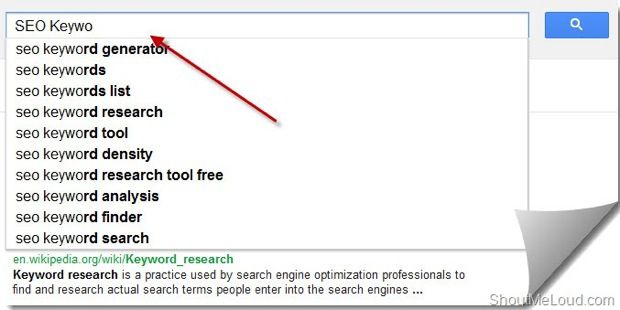
Google instant search is my first basis of finding a perfect Keyword. It’s more like a Keyword discovery tool, which you can use to generate tons of ideas. Though, you can’t actually use all of them, but for initial step it’s good to brain storm some ideas for K/w research. Put any Keyword related to your niche, for example, I started typing “SEO Keywo” and Google instant search suggested search results. Depending upon your post type, you can pick couple of them which make sense to you. Look at this screenshot: Google Instant search Keyword suggestion Once you have found 3-4 such Keywords, start adding it to Google Keyword suggestion tool and perform a search. So I  picked two keywords from the list: “SEO Keyword Search” & “SEO keyword research” as both are similar and make sense for my niche, and I can come up with a post on that. Now next step is to find if these two Keywords are going to do any benefit in terms of traffic, or just going to be another article with not much value from traffic POV. Lets move on to next step:
Keyword search analysis:
Now, I will put both the Key words in search tool and perform a search, it will give me details for search type I’m performing and also show relevant Keyword ideas. Now, that is keyword goldmine for you, as it will let you find many relevant Keywords that you can target in same post or else can come up with a follow-up posts.
Keyword ideas from Keyword planner tool
I usually target 2-3 Keywords/post. You can create your own SEO strategy depending upon your post quality and length. So, for the information sake, we have selected only Two keywords as shown in above picture and it’s time to check, which one of them is less competitive. Before that, you can change your filter to see if your target Keyword has any exact match type or not.

Checking Keyword competition using Traffic Travis:

There are many Keyword competition checker tool and some of them which I usually use are SEOmoz Pro and Traffic Travis. T.T being a desktop solution is easier to use. Open Traffic Travis and go to SEO > Competition tab and enter both your Keywords and perform a search. You will see a result like this:
Keyword Difficulty check
As you can see here, according to competition checker tool, “SEO keyword search” is easier to rank. These tools, consider many factors that includes domain age, backlinks, on Page SEO, page rank, DMOZ submissions and many more factors. You can also click on “view details” to see more detailed results for your competitor. Here is a detailed competition report for my target Keyword : (For first top 10 results)
Keyword Competition details As you can see, from the result on how important it is to have Keywords in your Title, description and H1 tag. Along with above mentioned points, backlink and social media promotion is one major factor for better ranking. Also, my suggestion book your domain for longer time-period, like 2-3 years.
What next?
So now, we have one keyword with us, and similarly you can find many keywords related to your niche. It might be the little time-consuming but it’s worth more than spending un-targeted ten posts. Now, your next target should be writing a Keyword optimize article (SEO copy-writing), and you can refer to our earlier guide on OnPage optimization.
Never forget, this Keyword research is just a primary steps, and real magic starts with your content. Moreover, never try to get traffic on the wrong keyword, as it will affect your overall blog performance in terms of Avg. Time on site and bounce rate. For your old blog articles, if you have not optimized them for any Keyword, you can use Google analytic data, any software for
For your old blog articles, if you have not optimized them for any Keyword, you can use Google analytic data, any software for Keyword research and work on re-optimization for Keyword. I did this for almost 30% of my old posts, and they started ranking in 1-2 page in ranking.

What Makes A Backlink A High Quality Backlink?

Getting backlinks – links from other websites to your business’s website – is the most effective way to improve your rankings. Not all backlinks are equal though. Some backlinks won’t improve your rankings at all, and some might even have a negative effect. Therefore, your focus should be on acquiring high quality backlinks.

What makes a backlink high quality is subjective, and every SEO consultant will have at least a slightly differing opinion on the topic, however, most would agree that a good quality backlink would be comprised of several of the factors listed below, and that a backlink that ticks all of these boxes would be the perfect backlink.

It would be unrealistic to expect all of your backlinks to be perfect, and just because a backlink doesn’t meet all of these criteria it doesn’t make it low quality. If you can get a backlink to your business’s website that ticks at least a few of these boxes then it’s definitely worth having in your site’s link profile.
From a relevant source
 
Search engines want to provide relevance in their search results, and so it’s logical that relevance is a consideration when they evaluate backlinks, which are the primary factor affecting where sites rank in their results. A backlink can be relevant on different levels. Search engines consider the overall relevance of the linking site, the relevance of the specific page with the link on it, and the relevance of the content directly surrounding the link.

From a trusted source
It’s logical that a high quality backlink would come from a high quality website, and that a high quality site would also be a very trustworthy site. To determine if a website is trustworthy, search engines use a set of trusted seed sites (for example, Wikipedia, BBC, The Huffington Post, etc.), which they know for sure are high quality and which are difficult to get links from. The fewer the number of links away a site is from one of the seed sites, the higher its TrustRank is, and the higher the quality a link from that site is.
Sends traffic
 
This aspect of backlinks too often gets forgotten about. The original purpose of links, before the time search engines started using them as a factor in their algorithms, was to add value to a page by directing visitors to resources relevant to the topic of that page. Visitors still click these links as often as they did when the internet was first created, and having a link in a prominent position on a highly visited page makes it high quality because, regardless of rankings, it will bring your website a continual stream of targeted visitors.
Exact/phrase/synonym match anchor link text used
 
The quality of a backlink increases if the words that form the clickable text of the link are the same as, or similar to, the words that you’re trying to improve your rankings for. It looks unnatural to have a lot of incoming links made up of exactly the same anchor link text though, so use plenty of variations. If you’re trying to rank your site for ‘mortgage advice’, as well as getting links with ‘mortgage advice’ as the anchor link text, good variations would be ‘advice on mortgages’, ‘professional mortgage advice’ and ‘mortgage guidance’.

In-content
In-content backlinks (i.e. backlinks within a block of text) are the most likely to be editorial links, which are exactly the type of links that search engines value most, and if a link is included early on in a piece of content then it’s natural to assume that the author of that content considers it be an important link. Therefore, a backlink within the main content area of a page, and towards the top of that content area, is considered to be more high quality than a link lower down the page or in the sidebar or footer.

PageRank (PR) is the most basic and obvious measure to use when assessing the worth of a backlink – the higher the PR of the page where the link is located, the higher the quality of that link. PR can be a misleading metric though. All webpages start off with a PR of 0 (or n/a to be precise) and the PR of a page can rise and fall over time. Also, the PR value that Google displays for a page is only updated for the general public every 3 or so months, but within the algorithm it’s updated constantly. So, the PR value you see is only an estimate, and could well be a point or 2 off of the true PR.

Next to backlinks to authority websites
If a backlink to your business’s website is included on a page that links to high quality sites, especially ones in the same niche as your site, then it indicates to search engines that your site should be put in the same bracket as those high quality sites. If the other links on the page are to low quality sites, then your site won’t necessarily be classed as low quality also, but rather search engines may opt not to include those links as a factor, either positively or negatively, in their ranking calculations.

From a different source to your existing backlinks
There’s a strong correlation between higher rankings for a website and the number of unique websites (i.e. different domain names hosted on different IP addresses) linking to that site. All else being equal, it’s preferable to have 10 links from 10 different websites than 100 links from 3 different websites. So, for a new link to your business’s website to be considered high quality, it should be from a website which hasn’t already linked to you.

Not reciprocal
Link exchanges were widely abused in the past, which resulted in the value of reciprocal links being reduced. Reciprocal links do still have value, and there’s certainly no risk of a penalty being applied as a consequence of them, however, if you’re looking for a backlink of the highest possible quality, then it should come from a website that you’re not also linking to from your own site.

The trust and authority flowing through a page with a backlink to your site on it gets divided up between all of the links on that page, and so the less links there are on a page, the higher the quality of the links on the page, as the the trust and authority passed on is less diluted. It depends on a few factors, but as a rule of thumb, having a link to your site share a page with less than 10 other external links would be considered good.

Not easily acquired
The more easily you can acquire a backlink, the less value it will likely have. The chances are that if you can get it a couple of minutes, or with a couple of clicks, then thousands of people will have done it before you and thousands more will do it after you – including your competitors if they…

Top 10 Most Expensive Google Keywords : Most Expensive PPC Keywords

How does Google make money? Surprisingly, 97% comes from online pay-per-click advertising. At WordStream we can’t get enough PPC; that’s why we decided to conduct some research and find out what the most expensive keywords are in Google. Some of our results about the most popular and most expensive PPC keywords were to be expected, while some (like cord blood and mesothelioma treatment) surprised us and our readers.

Note: If you don't quite understand this infographic, consider learning more about what is Google AdWords.
The Top 10 Most Expensive Keywords are:
  1. Insurance
  2. Loans
  3. Mortgage
  4. Attorney
  5. Credit
  6. Lawyer
  7. Donate
  8. Degree
  9. Hosting
  10. Claim
You’ll notice that these top ten most expensive AdWords keywords deal primarily with financing and industries that manage vast sums of money. The fact that the educational keyword “degree” is one of the top ten most expensive Google keywords, right up with lawyers and credit, reminds us of the growing cost of education.
The next ten most expensive keywords complete our total list, resulting the top 20 most expensive AdWords keywords:
  1. Conference Call
  2. Trading
  3. Software
  4. Recovery
  5. Transfer
  6. Gas/Electricity
  7. Classes
  8. Rehab
  9. Treatment
  10. Cord Blood
There you have it – the highest cost keywords. If you are considering entering into one of these industries, be ready to pay high cost per click rates for the top keywords. While some may start treatment facilities for the greater good, be aware that you’ll wind up in one of the most expensive niche groups, and your paid search marketing wallet will suffer from those high CPCs.
The most expensive SEM keywords may be frustrating for those in the industries, but they are the best keywords for Google, who makes 97% of revenue from advertising on Google sites (AdWords, AdSense). In the last four quarters, the biggest player of search engine history brought in $32.2 billion in total advertising revenue.

How Does Google Make Its Revenues?

Many people are surprised to find out that Google makes 97% of their revenue from online pay-per-click advertising. We decided to dig in and break apart exactly which keywords makes Google the most money.

How Was the Data for the Most Expensive Keywords Study Compiled?

For the Most Expensive Keywords Infographic, we compiled data from our own large keyword database and the Google Keyword Tool to determine the top 10,000 most expensive English-language keywords over a 90-day period.
We then organized the grand total keyword list into categories by theme, such as "Credit," or “Insurance.” The largest keyword categories were determined by weighting the number of keywords in each category, as well the estimated monthly search volume and average CPC for each keyword.

Why is Quality Score Important For Bidding on Competitive Keywords?

Quality Score is key for using AdWords effectively and getting the most out of your advertising budget. When bidding on competitive keywords, Quality Score is especially crucial because High Quality Scores can help you lower your average cost-per-click.
If you’re concerned about your Quality Score, try running the free AdWords Grader, a free tool that helps advertisers evaluate their PPC campaigns based on important metrics like Quality Score. If you score low, Quality Score can be improved by writing more targeted ad text and landing pages.

How Many Posts are Needed in a Blog to Get Approved by Google Adsense?

I was also searching for the question when I started blogging three years back in a free blogspot platform and was struggling to get approve by Google Adsense. I searched a lot in the internet, in different forums or also asked to pro bloggers. I had also got different answers from different sources. But still was not successful to get approved by Google Adsense. While checking the search terms of my blog, I still find that some people search with the term “how many posts needed to get approved by Google Adsense” or like “how many post for Google Adsense” or “how many blog post for Google Adsense“.
Google_Adsense_Things_You_Need_To_Know
May be the new bloggers who has just started blogging or entered in the vast world of blogging, are searching to earn some money from their blog through Adsense but is not successful are searching for this kind of answers. Keeping them in mind I started writing the article and I want to let you know that the answer is just not a numerical number like 20 or 30 or 100. I need to explain the whole thing so that you get a clear idea about this.
How Many Posts are Needed to Get Approved by Google Adsense?
Actually this is not an answer which can be given just by a single word. When I started blogging in blogspot, at first, I managed to post around 25 posts and then applied for Google Adsense. But the result was negative. Google did not approve my blog for adsense. Then I posted another 10 posts and again applied for Google Adsense. But the result was again the same. As the answers and reasons from Google are almost anonymous, it was hard to find the points which were missing in my blog. Then after a close look, I had found that the missing point is that my blog has some lines in the content which are copied from other website. In the beginning I was not aware that Google will penalize me If I copy content from other website. Though the contents were not fully copied but still Google detected those lines.
Then I deleted all those articles and written about 15 articles within one night with appropriate pictures. I did not copied those pictures again. I created some pictures using MS Paint and used those in the articles. Then applied for Google adsense. This time Google congratulated me! Ha ha .. I was the winner that time and Google Adsense was displaying in my blog.
I had written the story of mine because I want to provide you some message though this story. First of all, if you want to get approved by Google Adsense then do not even think of copy content from other website. Try to write original content as much as possible. Google does not like copied content.
Second thing, you need to keep in mind that If you want to get approved by Google Adsense then please do not write posts only with 100 or 120 words and one pictures. Try to write a post at least with 500 words. Then add one relevant picture and add the picture which is not copyright protected.
If you are posting content like this then post at least 20 contents. Then the process is still not over. Wait for at least 20-25 days. At least 3 weeks, before applying for Google Adsense. Add some social share plugin in your blog or share those articles in social networking site like Facebook , Twitter , Pinterest or StumbleUpon. Then try to build some backlinks to other blog or submit your blog to some popular online blog directory and also submit your blog to some popular search engine.
Keep your blog design as simple as possible and do not add other advertise network to your blog. Now, this is the time for you to apply for Google Adsense. Apply for Google Adsense and I am sure that you will get approved by Google Adsense.
So, the summary is, Google Adsense approval does not only depend only on the number of blog posts. You should publish only unique content to your blog, then need to have some social share and need to submit your blog to some search engine and wait for sometime if your blog is new.
Best of luck new bloggers! I hope you will come out with the flying colors. Happy earning with Google Adsense!

How to Do SEO for BlogSpot Blogs

Two famous ways for blogging and one is BlogSpot and another is WordPress. BlogSpot is for the beginners and WordPress is for the advance bloggers. Search Engine Optimization is must to rank your keywords and increase traffic for your website. What SEO do is to rank your keywords on Google and it works when someone searches with the keyword. Google SEO algorithm follows about 60-70 percent for On Page SEO that means on site SEO.

Optimize Post Title In BlogSpot:

Here I am talking about the page title for each article which you can see alongside favicon on the browser tab. Normally it shows like “Blogging Tips: How to Add Favicon on BlogSpot” something like this and this is not SEO friendly at all. It will be good if it only shows the page title and it is possible. To do that, you have to go to Template and then Edit HTML. Find the code “<title><data:blog.pageTitle/></title>” and then replace the code above “<b:if cond=’data:blog.pageType == “item”‘>
<title><data:blog.pageName/> |<data:blog.title/></title>
<b:else/>
<title><data:blog.pageTitle/></title> </b:if>”
Now save template and its done.
Custom Permalink:
You can change your permalink structure by yourself. Good permalink structure is using (-). Example: Page-Title-For-Your-Article. There will be two options. One is to automatically generate your permalink structure and another is to create custom permalink. You can edit your permalink by clicking “Custom Permalink” option. 

Adding Site Description:
Your website description is must for good SEO. You can setup your site Meta description by going settings and then click “search preferences”. Under “Meta Tag” you will find description that is by default disabled. Click on “edit” and then select “yes”. Then type your desired Meta description including your keyword. Done……….
Now you can add Meta description for each article. You can find it at right side under “search description” when composing your article.
Custom Robots.txt Setup:
This is very important for your site. This will help your site index. So you need to setup a rule that how the Google bot is going to index in proper way. If you do any fault with this then it will harm your site. You have to type some text like below:
User-agent: Mediapartners-Google
Disallow:
User-agent: *
Disallow: /search
Allow: /
You can find description of this code on Google search and then try your own text. You have to go to settings and then search preferences. Under “crawler and indexing” you will find an option “Custom robots.txt”. Click on “Edit” and then select “yes”, now you paste the text rules for the Google bot.
Sitemap:
It’s very important to generate a sitemap for your site. Sitemap helps Google bot to crawl isolated pages from your website. Its vey useful and must have for every website.
Image Optimization:
Image search plays very important role to increase your website visitor and revenue. Proper image optimization helps a lot. Proper use of alt text in image using keywords with appropriate rules makes your site SEO friendly.
  • Name of the image should be “your-image-name-with-keyword-variation.jpg”
  • Do not do keyword stuffing
  • Use long tail keywords for image name and alt text.
  • Use different but similar keywords in alt text for more than one image in single article.
Some Drawback of BlogSpot in terms of SEO: Here is the problem with BlogSpot and that is BlogSpot is not SEO friendly as WordPress. Some are below:
You Will Have Permalink Structure Problem:
Permalink structure is not SEO friendly. There will be a format like yourwebsite.com/year/month/page-title, which is not SEO friendly at all. Google I guess may not solve this problem in future.
Page Title And Meta Title Will Have To Be The Same:
Your page title and Meta title will be same. It will be good if the page title and Meta title is different. There is no solution until now and hopefully Google will solve it in future.
There Will Be No Subcategory:
You can only create Label/category but you cannot create subcategory under a Label/Category. This is a major issue and it will hurt your sites navigation problem and decrease your page views. I did not find any solution for this that I can share with you.
Image Uploading Problem:
If you upload an image then it will not saved as your website address
Uploading image is must but in BlogSpot if you upload an image, it will be saved in another Google website. This is another major issue, which is not SEO friendly. You can solve this problem by uploading your image in github under your subdomain and then add it to your BlogSpot to make it SEO friendly.
BlogSpot is appropriate platform for the one who is entry-level blogger. It will help them almost many things to do blogging and earn with that. Google have plans for this platform with good features in future. Its free, uses Google cloud, which is safe from hackers. Google products like Google plus, Google Page Speed and others are usable in this platform. 

Make Money Online With Payoneer minimum payment

Make money online with Payoneer partners paying at the lowest payment threshold. When we work online, we expect fast payment. In fact, the lower an internet money making program paying threshold is, the faster you will reach the minimum payout; happier you’ll be.
As you know, Payoneer is a convenient way to get paid online. A physical debit Mastercard is sent to your home address for free; you can use it to purchase at online store, offline store and to withdraw at local ATM machine in your own currency. Don’t get your own already? Start now, get $25 free when you upload $100: get a debit card powered by Payoneer for free!companies paying with payoneer


How to make money with payoneer partners?

I wanted to add clarification first. This post is not about how to make money online with payoneer refer a friend program. This post is about online work at home jobs and paying programs that are payoneer partners; and those programs pay at low minimum payment; people often call them “payoneer online jobs”.
A payoneer partner is a program, a company, which is allowed to provides Payoneer powered debit MasterCard to its customers and workers. The similarity between these programs are the payment methods. They differ in the way you can use them to earn revenue. So, what ever your skill level, your fields of interest, you’re ready to go with this payoneer partners’ list.
payoneer partners companies
This is a list of Payoneer partners who make payment process at low minimum payout:


SignUp Now to Get Free MasterCard :)

$10 minimum payment threshold program paying through Payoneer

adf.ly : Shorten links to share on the internet. Get paid $1 to $5 per mille views. Get paid through PayPal at the minimum of $1 and $10 through Payoneer prepaid MasterCard! Daily payment for 1 month old users and previously paid users; Monthly payment for general publishers.
                                           Sign Up Now for adf.ly Free account

Payoneer partners paying at $20 minimum payout

Exoclick: It is cost per click, cost per view, cost per action ad media for web and mobile platform. The minimum payout is $20 through Payoneer weekly.

Kontextua: Kontextua is a display, inlink and ads in image advertising network. They are paying through Payoneer at $20 minimum.

Sharecash: Sharecash is a paid per download file. Get up to $1 for each download, the minimum payout through debit card is $20.
                                           Sign Up Now for Free ShareCash Account

SeoClerks: Seoclerks is a micro jobs site paying via payoneer. Make money online completing micro tasks and get paid through Payoneer, Paypal, Western Union, etc… Get paid into your free debit MasteCard when your account balance reach $20.

$25 minimum payout – payoneer partners

Text-link-ads: It is a link marketplace where advertisers buy link place on publisher website. You will get paid monthly if your account or equal or greater than $25.

reviewme: Get hired to write product, website reviews. The reviews may be positive, negative or neutral. Up to $100 per reviews, get paid when you have $25 or more $ in account.


Mediashakers: It is a cpc, cpm, cpa ad network. They are paying at $25 via Mediashakers debit card powered by Payoneer.

Adbooth : Adbooth is an ad network split into a cost per mille and a cost per action network. It is one of the internet money making program where you can cashout your earning via Payoneer debit MasterCard.

$30 minimum payout

freelancer: It is the world most large freelance marketplace. Get hired and complete outsourcing projects. Withdraw as soon as you accumulate $30 in balance account.

plimus: sell your own products or promote someone else product as an affiliate. Withdraw your money when you have $30.

Elance: Elance for electronic Lancing is an outsourcing and freelance marketplace where you can make money online and get paid through Payoneer at $20 minimum payment threshold.

$35 minimum withdrawal via Payoneer

bluesnap: promote products as marketer and get sales. Get paid through Payonner, Ach, wire and PayPal at $35 minimum!

$50 minimum payout

Infolinks: Monetize your text with infolinks, they are paying twice a month when your earning is above $49.
Copacet: Copacet is a gaming related ad network which pay on NET 5 through Payoneer debit card when your earning reach $50. Get up to $15 per mille views for pop under game advertising.
Peerfly: Peerfly is an CPA affiliate marketing programs paying through payoneer at $50 minimum payment threshold. It is an high paying CPA program; earn up to $300 per action (signups, leads, sales, visits, etc…).
depositphotos.com: earn up to 15% from referred sales; get paid up to $20 for placing depositphotos.com banners on your photography related website. Get paid in DepositPhotos Prepaid debit MasterCard powered by Payoneer.

$100 minimum payout

dreamstime: dreamstime is a professional stock photos sites for free and paid photos. You earn money as contributor or affiliates. Get paid $5 per signup and 10% per transaction as affiliates; earn 25 to 60% per sale of photo you contribute. Get paid at $100 minimum payout through Payoneer, Moneybookers, PayPal and check.
IStockPhotos: Stock photos site by GettyImages.com! Get paid 15 to 45% per sale of photo you contribute to the photo bank. Get paid through Payoneer, check, PayPal and moneybookers at $100 minimum.

Join and make money online with payoneer partners which set low minimum payment threshold and are reputable among internet money makers. Don’t limit yourself to payoneer’s official partners. Remember that you can get paid through payoneer from any company paying through ACH/Direct Transfer or PayPal; you just have to activate payoneer Us payment services. Enjoy!…

Best Tricks to Get Free Traffic

Get free traffic it means you can get visitors to visit your website or blog freely without paying anything. Right now on the web there are million tricks to get free traffic to your website or blog. But some ways may cause your website or blog has been banned or penalty by search engine. Especially from giant search engine is Google. So how to get the right way to build free traffic to your website or blog without getting any barns or problems from the search engine such as Google, Yahoo, MSN or others?

Getting free traffic online is easy but it’s not a day process and it does take time and dedication but it is worth if you seriously want to earn money online. Please remember that when you start building traffic to your website or blog “build everyday 1 backlink to your website, 1 month you will get 30 backlinks and 1 year you will get more than 350 backlinks”.
One of the best tricks is submitting your website or blog to a biggest search engine is Google and it’s free. With this way you can bring in hundreds or even thousands of visitors per day freely to your website or blog. When you submit your website or blog to Google, please try to wait patiently while Google index it. It can take a few months. But in this time you can build more backlink or update your articles or you can do the same way by submit your website url to Yahoo, MSN, etc.
Don’t just wait for seeing your website or blog index by Google or other search engine. But you can do many things for your website or blog such as building more backlinks from doing some comments on the other forums or some web directories (but don’t forget to leave your url there).

Get Free Traffic System

1. To get list in search engines, just submit your website to dmoz.org
2. Submit your website to Search Engines and web directories:
Google: http://google.com/addurl.html
MSN: http://search.msn.com/docs/submit.aspx
Yahoo: https://siteexplorer.search.yahoo.com/submit
or http://search.yahoo.com/info/submit.html
40 search engines: http://submitexpress.com
Top 20 search engines: http://addme.com New
Search Sight: http://searchsight.com/submit.htm
Arakne Links: http://www.arakne-links.com/submit.php
Info Tiger: http://www.infotiger.com/addurl.html
Sonic Run: http://search.sonicrun.com/freelisting
Web world: http://www.webworldindex.com
Submit Biz: http://www.submit.biz
Skoobe: http://www.skoobe.biz
Dramba: http://www.dramba.com
Directory Storm: http://www.directorystorm.com
A1 web directory: http://www.a1webdirectory.org
Cyber Web Search: http://www.cyberwebsearch.com
Cuil: http://www.cuil.com/info/contact_us/feedback/crawl_me
3. Sign up your website with free traffic’s credits http://trafficswarm.com (don’t buy credit and don’t use this method if you are using Google AdSense). Not recommend.
4. Sign up with some social networking sites such as Facebook.com or MySpace.com
5. Sign up a Twitter account if you don’t have one www.twitter.com and connect with your Facebook & MySpace.

6. Sign up a blog with wordpress.com to join with www.tweetmyblog.com to instantly transform your Twitter account into a traffic hurricane to your blog! Don’t forget leave some backlinks in your blog to your website. Let’s see topic “Traffic from blogs“.
7. Finally, go to traffic from twitter to twist your social networks with twitter.

Beside the above free traffic system, you also can get more and more free traffic to your website or blog from our 3th topic “build web traffic” such get free traffic from twitter, youtube, blog and more.

Free Backlinks Submitter

Below is the list of backlinks free web directory that you can submit your website to there without reciprocal link. So you can get free backlinks to your website to increase your Page Rank more for better SEO (Search Engine Optimization) and finally you Get Free Traffic.
1. http://freebacklink.net/
2. http://nickstraffictricks.com/1537_free-back-links-to-your-site/
3. http://simplesitesbigprofits.org/free-back-links/
4. http://myrtlebeachhouserentals.org/free-backlinks/
5. http://www.curefortoenailfungus.org/free-back-links/
6. http://backlink.us/

TLC Team

How to Register a Domain Name

Hey there future site owner,
I'm going to clue you in on some tips most people don't absorb prior to registering a domain name.
There have been a lot of changes on the web in recent years so make sure you read this entire page so you pick the ideal name for your website.
NOTE: If you already know about domain names and don't need any extra advice, go here to register.
A domain name is the home of your website and often ends in extensions like .com, .net, .org, .info, .us, .biz, .tv and more. Today there are numerous extensions available, but .com is still the most popular by far.
Once you have registered your name, you will select a web host (2nd step).  The web host is the guts of any website because this is where you create and publish your pages, create a blog, create email addresses, add functionality and maintain your site.


Steps to Registering a Domain

Reserving a domain name is easy, inexpensive and only takes a few moments. The big name companies like Register.com and NetworkSolutions.com charge ridiculous prices such as $30-35/year for one domain name, and you get the same service at WebsitePalace.com.
It doesn't matter where you register your domain.  Almost every registrar provides the same services.
You can save a bundle at WebsitePalace.com, and you'll have access to free domain forwarding. (Forward any domain to any site for FREE!)

Keyword Rich Domains

For search engine optimization (SEO) purposes, many experts recommend registering a domain with keywords you want to be found for. While this was a must years ago, it's not quite the necessity it once was.
In fact, there was a very big Google update in October 2012 called EMD (Exact Match Domain update) that targeted domain names that were only ranking because the name matched the targeted phrase.
That's not to say you shouldn't register a name that has the keywords you want to target, but don't expect to rank well just because you choose a keyword-rich name. Getting ranked well in Google is a very complex task. The domain is not as big of a factor as it used to be.

Going For The Brand Name

Some people prefer to go for a shorter, brandable domain that's easier to remember -- especially because so many "good" domains are taken these days.
So instead of registering a keyword-rich name like HealthAndWellness101.com, you would register a made-up name like Fitzee.com. Fitzee means absolutely nothing, but it's short, catchy and easy to remember.
Plus, it would look a lot better on a shirt, mug or hat than a 4-letter domain. :-)
I still think it's a good idea to aim for the keywords you want to target. Descriptive names can have advantages. For example, it automatically tells the potential visitor what the site is about.
Having said that, don't make your domain name so long and awkard that it's hard to read and remember. It's really about finding a balance. Also, don't be shy about bouncing ideas off your friends and family before registering.
Here's another tip. Write the name down to give you an idea of what it may look like on business cards, T-shirts and other printed materials.
Remember, your domain is a big part of your brand, so take your time coming up with the right name for your site.

How to Easily Increase Your Google Adsense Revenue (Easy Way)

There are many blogger or website owner only use Google adsense program to earn money. Some times they are banned from Google adsense program because they use many tips and tricks to earn more adsense revenue. Here I share some tips how to easily increase your google adsense revenue.

Tips-1: Before you registration in Google adsence revenue program, you should read the google adsense adsense complete TOS . It will help you to realize the Google adsense revenue program.

Tips-2: Be update!! It is most important to update your website on regular. Google loves fresh and regular contains.
Tips-3: Direct Search Engine traffic is the best way to get traffic. More traffic more click and more money. It is the simple equation. For this you must deliver unique and fresh content.
Tips-4: Add placement is one of the important issue for earning more revenue.Select direct visible area for your add. You can experiment with your add placement for 7 days to know which is the best add placement positions for your website.

Tips-5: SEO for your website is the key rule to increase traffic and more revenue.
I am not adsense boss. You can use those basic tips and tricks to earn more adsense revenue. I hope it helps you.


In SEO, The Best Technique Is No Technique!

As someone of Asian-American decent, I like so many of my peers grew up idolizing Bruce Lee. I remember spending my youth watching his movies, and I actually even trained in Shaolin Kempo and Tae Kwon Do for 8 years. So what does this have to do with SEO? Well the other day as I was watching one of Bruce Lee’s old movies in my spare time, I came across a clip that for whatever reason at the time reminded me of what is being touted by Google as the best “technique for SEO”. Here is the video clip of what I was talking about, can you catch the parallels between what Bruce is saying and today’s modern day SEO landscape?
Did you get it? At about the 0:23 mark Bruce’s teacher asks “What is the highest technique you hope to achieve?” to which he responds “To have no technique”, and interestingly enough this is one way that is actually a fairly effective strategy in your quest to gain search engine traffic. Let me explain.

Remember Google doesn’t want us to actively engage in manipulating search engine results. They tell us if we want search engine traffic, then all we have to do is focus on creating great content that people will want to share, and then the Google overlords will bless us with server melting traffic to our websites! So according to Google, the best SEO technique is to have no SEO technique! Welllllllllll yes and um no.

Of course at the heart of any good website is the creation of good content. You need to have content that engages your readers, and ideally you want to have lots of it. However for the most part I live in the real world where people don’t read stuff and say “OMG that was a great article, I’m now going to jump on my high PR blog and write an article about it and link to it”. This just doesn’t happen people, or if it does it is pretty rare. So what we have to do is create this content and then go out there and promote it, but promote it in the right way.

So I think probably the easiest example would be to use this blog. When I first started this blog, I absolutely did no linkbuilding. All I did was write, write, and write some more. Remember Google tells me all I have to do is “create great content” and then search traffic will be mine! However after writing about 45 articles or so for the site, I still had zero search traffic! I outlined the results in my article here, but basically at that point I threw in the towel and began linkbuilding.

So briefly after I “threw in the towel” on relying on content alone, I started to do a little bit of linkbuilding. Nothing too heavy, just a few high PR blog posts and some forum signatures on popular internet marketing forums I regularly post on (Warrior Forum + Black Hat World). However a little while after I started linkbuilding I got really busy with client obligations and I went back to focusing on only writing for this blog (no linkbuilding). I also did begin to utilize social media, and I would tweet on Twitter and post on Facebook occasionally some of the stuff that was being produced here.

After focusing on creating content and the occasional social media promotion, I did notice that traffic from search engines started to rise. Basically I would try to post once a day about things I thought my readers would find helpful, and then maybe tweet the link or post a link on Facebook. However it seems that with each passing day the search engines started giving me more love. Coincidence? Was it true that maybe the best technique was to have no technique? Well the jury is still out on that.

Some of you may be thinking “well you did start to use social media, so maybe Google is giving you love because of that”, well this could be true, but I have found in all of my tests that social media in itself does not rank a site. If you built a website and tried to purely rank it with social media, assuming that people that you reach via social media don’t begin linking to you from their own web properties, links from Twitter and Facebook in itself as of now is not enough to rank a site (someone please prove me wrong!).

So what should you take away from all this? Well I would say if you haven’t done so already, try to create an authority site in some evergreen niche and really just focus on writing for the site. Then set-up all the social media platforms like Twitter, Facebook, Google Plus, and a YouTube channel. Write articles, tweet tweets, post to Facebook, create a YouTube video that links back to the site. Focus on banging out great content and using these social media platforms every now and then to promote it. Then in a little bit watch the search engine traffic rise. So maybe it’s true that the best technique is no technique (no active linkbuilding, only promotion), but the only way you’ll find out is if you actually give it a try! :)

5 Tips On Using Google AdSense To Make You Money


Google AdSense can be an absolute goldmine for anyone who is willing to invest some time in learning how to use it effectively. A lot of people who start using Google AdSense tend to get turned off by it within the first couple of months because they just don’t seem to be making the money that they had expected.
Arm yourself against making the typical newbie mistakes and read our tips below so that you’ll know just how you can make some good cash off of AdSense.

1. Where Does AdSense Make Sense?

Perhaps the biggest mistake that those who use AdSense make is that they throw ads on every type of website imaginable. Don’t waste your time, effort and ads on sites that won’t be bringing in the cash.
Let’s take a tech info website for example. If you run a site that provides high level tech advice, then there’s a very low chance that anyone visiting your site will bother with your AdSense ads. Why? Because these people just don’t generally click on those types of ads. They know about AdSense, and they didn’t come to your website for anything but the information written on your site. They want answers to a problem, and then they want to get out.
Let’s say you have a website that’s more geared towards sales, however. This would be a better type of site to have ads on as people will be far more likely to click on the advertisements you put up.
It may take a bit of trial and error since some niches tend to do better than others when it comes to these types of ads, but generally speaking, if your blog or website is about selling things, then AdSense will work better for you.

2. “SmartPricing:” Anything But Smart

Whenever possible, you have to avoid Google’s “SmartPricing” scheme. With SmartPricing, Google gives advertisers a discount based on how popular or “valuable” your website is. They tend to base this on your site’s click through ratio.
So if your website has a high click through ratio, then the perceived value of your site is high so then the cost per ad click is higher. If your click through ratio is low, however, the value of your site is “low” so you get less money per click. The difference between a SmartPriced site and a non-SmartPriced site can be anywhere from a couple cents to several dollars in difference.

One way to avoid this is to post your AdSense ads only on your older posts. Why? Because anyone who regularly visits your site isn’t going to click on your ads. If you post them on your older posts however, you’ll be able to possibly keep your click through ratio pretty high. There are a lot of resources out there about how you can change the coding of your website or blog to keep your ads only on your older posts.
Another way to avoid the dreaded SmartPricing is to display your ads to those who have landed on your page through a search engine only. You can again tailor your blog using the “function” file to change where the ads are displayed.

3. Choose The Best Keywords

Google is all about keywords, so in order to make the biggest profit you need to choose the best CPC keywords out there. You can use a number of great tools out there to help identify what the high paying keywords for your niche are, and there are several lists supplied for free, such as www.rumler.com.
Keywords also determine what kind of ads are going to show up on your website or blog. Nothing’s worse than visiting a website that’s cluttered with ads that don’t even make sense. Target your keywords so that you’ll be able to “influence” what types of ads will show up on your blog or site. Make sure that these keywords are on your website or blog entry, but BE CAREFUL. If the keyword density is too high, you WILL be penalized by Google and can even be tossed out of their AdSense program.
TIP: Read Google’s terms of service. Once you’re out of the program, you’re pretty much out for good. Follow the terms of service, stay in their good graces, and write great content so you’ll continue to get visitors who’ll click on your ads.

4. Choose Big Ads

AdSense advertisements come in a variety of formats, so you can tailor the formats to see which works best with your blog. Having an advertisement that looks good on your blog or site is important, but keep this in mind: the large 336×280 rectangle sized advertisements has long proven to give the best payout. Maybe this is because the ad is right in any visitors face, or maybe it’s because that size can display video ads (which are increasing in popularity). Either way, it may be a good idea to start out with an ad around that size.

5. Monitor Your Success

No matter what you do with your blog or website, you need to keep track of how successful your ads are doing. If you don’t monitor your ads, then you will ultimately fail. You’ll be able to pin point which ads work, which don’t, and over time you may discover that certain ads work best at certain times throughout the year while others work best at other times.
One of the best things that we can suggest is that you look at your top 1/5 of pages, and then you take a look at your bottom 1/5 of pages. Why are the top 1/5 of pages making more money? What are you doing right? Try to take what seems to be working with the top 1/5 of your pages and then incorporate those ideas and methods into the bottom 1/5.
You’ll also be able to quickly see whether or not your chosen keywords are making money. If your keywords aren’t working, change them up! You should always do a top keyword run at least once a week to make sure that your site is up to date and current.

How to Make Money With Google Adsense | Tips On How to Get Started and Setting Up your Adsense Account

I became an Adsense publisher in April of 2005 when Google’s Adsense was just 2 years old from being launched.
Adsense is definitely one of the hottest ways to earn passive income of the century. All a person needs to do is to create an AdSense account. Build a website with unique and original contents. It is so effective that not only individuals but businesses have started using GoogleAds for passive income as well. Before we discuss tips and tricks on how you can make the most of AdSense, let’s read the answer to a very important question.
What do the terms residual income and passive income imply?
The use of the word, passive does not mean that you will have to do entirely nothing to earn regular income. Rather it means that the amount of resources you spend on an activity is very little in comparison to the revenue it generates. For example, after posting an interesting/controversial/informative article, you might continue to receive visitors on your blog for more than a year. Remember, some topics provide more passive incomes than others. For example a fashion blog will be able to generate less passive income because of the rapid changes in styles. A fashion blogger will have to continuously have to update his/her blog to keep readers abreast with the latest developments in the world of style. On the other hand, blogs and websites on relatively stable subjects such as education, health and relationships are more likely to generate more passive income because of their evergreen nature. There are many issues that people discuss again and again and information related to which remains the same. Hence, readers may continue to come on a certain blogpost related to for years.
On the other hand, the term residual income refers to the fact that AdSense is not your primary source of income. In fact, it is a fraction of the income you derive from your online activities. For example, a blog that discusses nail art and simultaneously sells nail art supplies to its readers is likely to make AdSense display advertisements related to the subject. Hence, the blogger will have to streams of income – one from the income of the nail art supplies and the other from AdSense. Since, revenue generated from AdSense will only be a fraction of the revenue from the sale of the nail art it has been termed residual income.
How to Use AdSense in an Effective Way. Let’s look at the Holistic Approach
If you are planning to use AdSense as one of the sources of income, there are a few tips you could use to make your endeavors more effective.
1. Number of Websites/Blogs and their Genres
There are two extreme ways of earning with GoogleAds. Earn $100 with 1 blog or earn $20 from 5 blogs each. When it comes to choosing between the two, we recall the old adage; don’t put all your eggs in one basket. Yes, diversification is the key to success when it comes to earning residual income through AdSense.

Following are some of the benefits of diversification.
a. Having more than one blog/website will allow you to cover a wider range of topics. If you decide to run three blogs at a time, you may cover very distant genres of entrees such as health, fashion and travel. This will help you cover three unique sets of consumer markets, news items and products.
b. Some genres are better more effective at generating passive income than others. As discussed above, it is a great idea to invest resources in at least one website/blog that is sure to generate a small but steady stream of visitors and thus passive revenue. The other blogs/websites may be on topics that require regular updates.
2. Attraction Marketing to Increase your Website Traffic and build your list!
Attactraction marketing is a technique that’s used not only by those who sell products but also who help those who sell products. This is true for blogs/websites that provide visitors with information or free online services. A few examples of such websites that cater free email services, provide news updates and make downloadable content available for free.
Regardless of the revenue from GoogleAds being residual or not, it is imperative that you increase the traffic to your websites and blogs. The more people will visit your blog/website, the higher the number of clicks will be on GoogleAds (even if the percentage remains the same).
3. Update your Contents on a regular basis!
It is true that the older articles get, the more they are shared among readers and the stronger their presence on their internet grows. And the stronger its presence is, the more people visit it and the more revenue GoogleAds placed next to it earn. However, this situation is applicable to articles that have the potential to appeal to readers over a long period of time. A few categories such as health, education and relationships are better able to retain the longevity of their articles. Others however serve readers best with fresh content.

Hence, to be able to generate lots of traffic and remain in Google’s ‘good’ books, make sure that you continuously update your blogs/websites with the latest info on the topics the platforms are about.
4. Positioning AdSense
Perhaps the most important thing to do is to place GoogleAds on your website in a highly effective way.

There are three things that you must keep in mind when configuring the settings.
a. Size
The basic rule that you must follow when placing ads on your website/blog is that of camouflage. The aim of doing so isn’t to hide the advertisement but to make it look like a part of the website itself. Although doing so entirely isn’t possible, your effort is bound to cause a positive change and make the advertisement more in sync with the rest of the website.
GoogleAds come in three different sizes:
i. Large rectangle –336×280
ii. Medium rectangle – 300×250
iii. Wide skyscraper – 160×600

Choose the size that suits your blog/website best. One good way of figuring out the right size is to consider the dimensions of other graphics/tables that are present on your site. Also keep in mind the website’s template. The greater number of columns a website has, the lesser flexibility it will have for larger advertising boxes.
b. Color
Another factor that must be used to taken into consideration when placing ads on a site is its background color. You may employ one of the three techniques mentioned below to maximize the number of clicks GoogleAds on your website generate.

i. Blend – Choosing the color of the advertisement to be exactly that of website’s background will give it a very subtle attraction. It is best for visitors who are averse to advertisements.
ii. Complement – You may also choose one of the two or more colors that your website contains. For example if your blog is primarily blue with green accents, you may choose green as the color of the advertisement. This too will make it look like a part of the website and will appeal to a wide range of audience.
iii. Contrast – A rather wild but at times effective idea is to choose a color for the advertisement which is nowhere in the website. Doing so will make it very prominent. And if the advertisement is alluring enough, even the greatest skeptics will click on it.
c. Position
Yet another important factor that affects the probability of an advertisement getting clicked on is its positive relative to other content present on the site. While many experts suggest placing advertisements right at the top of blogs/websites, the rule isn’t applicable in very case. One relatively safe option is to place advertisements on the right hand side. Other than that, it is best that the psyche of the website’s visitors be kept in mind when position ads.

If the website talks about something serious such as health, it is preferable that the advertisement be placed at the bottom or the side of the website (these are just my recommendations because I also blog on health care office management). This way the website will get a chance to first build credibility with the visitors. On the other hand, if the website is relatively frivolous in nature, it is okay to position ads even right at the top.
5. Things to Avoid when Using AdSense
AdSense comes with a set of dos and don’ts. While religiously following the dos don’t forget the don’ts are almost equally important. One wrong move and your AdSense account can be frozen. Following are some of the most basic don’ts Google does not tolerate.
a. Clicking on Your own Website’s Ads
If you have been trying to act smart by clicking on your own website’s Google Ads, you are not only wasting your time but even jeopardizing your Google Ads account. Yes, Google clearly states in the guidelines it provides to those using AdSense that clicks ‘originating from your IP addresses or computers under your control’ on the ads is a violation of the terms and agreements you consented to. Hence, the violation of the agreement may lead to the termination of your AdSense account.

b. Asking Others to Click on GoogleAds
Yet another action that is prohibited by Google is to ‘request … end users to click on Ad’. Often bloggers request their fans to click on ads on their blog by clearly explaining their motive. Even if readers do fulfill such a request, their clicks will be considered invalid.

c. Placing Ads on Restricted Sites
Google forbids users from placing GoogleAds on restricted website such as those which contain adult content. Even if the clicks on such ads are valid, they are not going to earn you any revenue.

d. Publishing Competitors’ Advertisements
GoogleAds is not the only network of advertisements. Alternatives do exist such as Yahoo Publisher Network, Bidvertiser, Clicksor, InfoLinks and Project Wonder. It may occur to you that using more than one publishing networks may result in greater total revenue given the variety of ads the two or more than two networks will display on your website. However, such an arrangement does not. Even if smaller publishing networks may be okay with being on the same page with others, GoogleAds is not.