Microsoft Windows is a series of
operating systems produced by
Microsoft.
Microsoft introduced an
operating environment named
Windows on November 20, 1985 as an add-on to
MS-DOS in response to the growing interest in
graphical user interfaces (GUIs).
[2] Microsoft Windows came to
dominate the world's
personal computer market, overtaking
Mac OS, which had been introduced in 1984.
The most recent client version of Windows is
Windows 7; the most recent
server version is
Windows Server 2008 R2; the most recent
mobile version is
Windows Phone 7.5.
Versions
The term
Windows collectively describes any or all of several generations of
Microsoft operating system products. These products are generally categorized as follows:

The classic Windows logo, used until the release of
Windows XP in 2001
Early versions
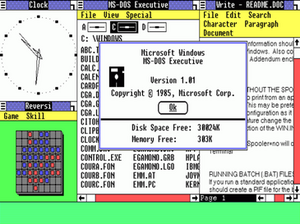
Windows 1.0, the first version, released in 1985
The history of Windows dates back to September 1981, when Chase Bishop, a computer scientist, designed the first model of an electronic device and project "Interface Manager" was started. It was announced in November 1983 (after the
Apple Lisa, but before the
Macintosh) under the name "Windows", but
Windows 1.0 was not released until November 1985.
[3] The
shell of Windows 1.0 was a program known as the
MS-DOS Executive. Other supplied programs were
Calculator,
Calendar,
Cardfile,
Clipboard viewer, Clock,
Control Panel,
Notepad,
Paint,
Reversi,
Terminal, and
Write. Windows 1.0 did not allow overlapping windows. Instead all windows were
tiled. Only dialog boxes could appear over other windows.
Windows 2.0 was released in October 1987 and featured several improvements to the user interface and memory management.
[3] Windows 2.0 allowed application windows to overlap each other and also introduced more sophisticated
keyboard shortcuts. It could also make use of
expanded memory.
Windows 2.1 was released in two different versions:
Windows/386 employed the
386 virtual 8086 mode to multitask several DOS programs, and the paged memory model to emulate expanded memory using available
extended memory.
Windows/286 (which, despite its name, would run on the 8086) still ran in
real mode, but could make use of the
high memory area.
The early versions of Windows were often thought of as simply graphical user interfaces, mostly because they ran on top of
MS-DOS and used it for
file system services.
[4] However, even the earliest 16-bit Windows versions already assumed many typical operating system functions; notably, having their own
executable file format and providing their own
device drivers (timer, graphics, printer, mouse, keyboard and sound) for applications. Unlike
MS-DOS, Windows allowed users to execute multiple graphical applications at the same time, through
cooperative multitasking. Windows implemented an elaborate, segment-based, software virtual memory scheme, which allowed it to run applications larger than available memory: code segments and
resources were swapped in and thrown away when memory became scarce, and data segments moved in memory when a given application had relinquished processor control.
Windows 3.0 and 3.1

Windows 3.0, released in 1990
Windows 3.0 (1990) and
Windows 3.1 (1992) improved the design, mostly because of
virtual memory and loadable virtual device drivers (
VxDs) that allowed them to share arbitrary devices between multitasked DOS windows.
[citation needed] Also, Windows applications could now run in
protected mode (when Windows was running in Standard or 386 Enhanced Mode), which gave them access to several megabytes of memory and removed the obligation to participate in the software virtual memory scheme. They still ran inside the same address space, where the segmented memory provided a degree of protection, and multi-tasked cooperatively. For Windows 3.0, Microsoft also rewrote critical operations from
C into
assembly.
Windows 95, 98, and Me
Windows 95 was released in August 1995, featuring a new user interface, support for
long file names of up to 255 characters, and the ability to automatically detect and configure installed hardware (
plug and play). It could natively run 32-bit applications, and featured several technological improvements that increased its stability over Windows 3.1. There were several OEM Service Releases (OSR) of Windows 95, each of which was roughly equivalent to a
service pack.
Microsoft's next release was
Windows 98 in June 1998. Microsoft released a second version of Windows 98 in May 1999, named
Windows 98 Second Edition (often shortened to Windows 98 SE).
In February 2000,
Windows 2000 (in the NT family) was released, followed by
Windows Me in September 2000 (
Me standing for
Millennium Edition). Windows Me updated the core from Windows 98, but adopted some aspects of Windows 2000 and removed the "boot in DOS mode" option. It also added a new feature called
System Restore, allowing the user to set the computer's settings back to an earlier date.
Windows Millennium Edition is often confused with
Windows 2000 (because of its name), and has been said to be one of the worst operating systems Microsoft ever released.
[5]
Windows NT family
The NT family of Windows systems was fashioned and marketed for higher reliability business use. The first release was
NT 3.1 (1993), numbered "3.1" to match the consumer Windows version, which was followed by
NT 3.5 (1994),
NT 3.51 (1995),
NT 4.0 (1996), and
Windows 2000, which is the last NT-based Windows release that does not include Microsoft
Product Activation. Windows NT 4.0 was the first in this line to implement the "Windows 95" user interface (and the first to include Windows 95's built-in 32-bit runtimes).
Microsoft then moved to combine their consumer and business operating systems with
Windows XP that was released on October 25, 2001. It came both in home and professional versions (and later niche market versions for
tablet PCs and
media centers); they also diverged release schedules for server operating systems.
Windows Server 2003, released a year and a half after Windows XP, brought
Windows Server up to date with Windows XP. After a lengthy
development process,
Windows Vista was released on November 30, 2006 for volume licensing and January 30, 2007 for consumers. And its server counterpart,
Windows Server 2008 was released in early 2008. On July 22, 2009,
Windows 7 and
Windows Server 2008 R2 were released as RTM (release to manufacturing) while the former was released to the public 3 months later on October 22, 2009.
64-bit operating systems
Windows NT included support for several different platforms before the
x86-based
personal computer became dominant in the professional world. Versions of NT from 3.1 to 4.0 variously supported
PowerPC,
DEC Alpha and
MIPS R4000, some of which were 64-bit processors, although the operating system treated them as 32-bit processors.
With the introduction of the
Intel Itanium architecture (also known as IA-64), Microsoft released new versions of Windows to support it. Itanium versions of
Windows XP and
Windows Server 2003 were released at the same time as their mainstream x86 (32-bit) counterparts. On April 25, 2005, Microsoft released
Windows XP Professional x64 Edition and Windows Server 2003 x64 Editions to support the
x86-64 (or
x64 in Microsoft terminology) architecture. Microsoft dropped support for the Itanium version of Windows XP in 2005.
Windows Vista was the first end-user version of Windows that Microsoft released simultaneously in x86 and x64 editions. Windows Vista does not support the Itanium architecture. The modern 64-bit Windows family comprises AMD64/Intel64 versions of Windows 7 and
Windows Server 2008, in both Itanium and x64 editions. Windows Server 2008 R2 drops the 32-bit version, although
Windows 7 does not.
Windows CE
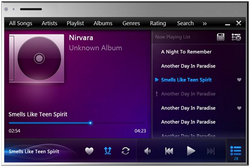
The latest current version of Windows CE,
Windows Embedded Compact 7, displaying a possible UI for what the media player can look like.
Windows CE (officially known as
Windows Embedded Compact), is an edition of Windows that runs on minimalistic computers, like satellite navigation systems and some mobile phones. Windows Embedded Compact is based on its own dedicated kernel, dubbed Windows CE kernel. Microsoft licenses Windows CE to
OEMs and device makers. The OEMs and device makers can modify and create their own user interfaces and experiences, while Windows CE provides the technical foundation to do so.
Windows CE was used in the
Dreamcast along with Sega's own proprietary OS for the console. Windows CE is the core from which
Windows Mobile is derived. Microsoft's latest
mobile OS,
Windows Phone, is based on components from both
Windows CE 6.0 R3 and the current
Windows CE 7.0.
Windows Embedded Compact is not to be confused with
Windows XP Embedded or
Windows NT 4.0 Embedded, modular editions of Windows based on Windows NT kernel.
Future of Windows

Screenshot of Windows 8 Consumer Preview startscreen (as of February 29th, 2012)
Windows 8, the successor to Windows 7, is currently in development. Microsoft posted a blog entry in Dutch on October 22, 2010 hinting that Windows 8 would be released in roughly 1 year.
[6] Also, during the pre-
Consumer Electronics Show keynote,
Microsoft's
CEO announced that Windows 8 will also run on
ARM CPUs. This Windows version will also be more suitable for
tablets and netbooks, featuring a more touch-friendly interface. Several new features will also be introduced, such as support for USB 3.0 and the ability to run Windows from USB devices (like USB Hard Disks or USB Flash drives) with
Windows To Go.
History
The first version of Microsoft Windows,
version 1.0, released in November 1985, lacked a degree of functionality, achieved little popularity and was to compete with Apple's own operating system.
[citation needed] Windows 1.0 is not a complete operating system; rather, it extends
MS-DOS. Microsoft Windows
version 2.0 was released in November 1987 and was slightly more popular than its predecessor. Windows 2.03 (release date January 1988) had changed the OS from tiled windows to overlapping windows. The result of this change led to Apple Computer filing a suit against Microsoft alleging infringement on Apple's copyrights.
[7][8]
Microsoft Windows
version 3.0, released in 1990, was the first Microsoft Windows version to achieve broad commercial success, selling 2 million copies in the first six months.
[9][10] It featured improvements to the user interface and to multitasking capabilities. It received a facelift in Windows 3.1, made generally available on March 1, 1992. Windows 3.1 support ended on December 31, 2001.
[11]
In July 1993, Microsoft released
Windows NT based on a new kernel.
Windows NT 3.1 was the first release of Windows NT. NT was considered to be the professional OS and was the first Windows version to utilize
preemptive multitasking.
[citation needed] Windows NT would later be retooled to also function as a home operating system, with Windows XP.
On August 24, 1995, Microsoft released
Windows 95, a new, and major, consumer version that made further changes to the user interface, and also used preemptive multitasking. Windows 95 was designed to replace not only Windows 3.1, but also Windows for Workgroups, and MS-DOS. It was also the first Windows operating system to use Plug and Play capabilities. The changes Windows 95 brought to the desktop were revolutionary, as opposed to evolutionary, such as those in Windows 98 and Windows Me. Mainstream support for Windows 95 ended on December 31, 2000 and extended support for Windows 95 ended on December 31, 2001.
[12]
Next in the consumer line was Microsoft
Windows 98 released on June 25, 1998. It was followed with the release of Windows 98 Second Edition (Windows 98 SE) in 1999. Mainstream support for Windows 98 ended on June 30, 2002 and extended support for Windows 98 ended on July 11, 2006.
[13]
As part of its "professional" line, Microsoft released
Windows 2000 in February 2000. During 2004 part of the Source Code for Windows 2000 was leaked onto the Internet. This was bad for Microsoft as the same kernel used in Windows 2000 was used in Windows XP. The consumer version following Windows 98 was
Windows Me (Windows Millennium Edition). Released in September 2000, Windows Me implemented a number of new technologies for Microsoft: most notably publicized was "
Universal Plug and Play". Windows Me was heavily criticized due to slowness,
freezes and hardware problems.
In October 2001, Microsoft released
Windows XP, a version built on the Windows NT
kernel that also retained the consumer-oriented usability of Windows 95 and its successors. This new version was widely praised in computer magazines.
[14] It shipped in two distinct editions, "Home" and "Professional", the former lacking many of the superior security and networking features of the Professional edition. Additionally, the first "Media Center" edition was released in 2002,
[15] with an emphasis on support for DVD and TV functionality including program recording and a remote control. Mainstream support for Windows XP ended on April 14, 2009. Extended support will continue until April 8, 2014.
[16]
In April 2003,
Windows Server 2003 was introduced, replacing the Windows 2000 line of server products with a number of new features and a strong focus on security; this was followed in December 2005 by Windows Server 2003 R2.
On January 30, 2007, Microsoft released
Windows Vista. It contains a number of
new features, from a redesigned shell and user interface to significant
technical changes, with a particular focus on
security features. It is available in a number of
different editions, and has been subject to
some criticism.
On October 22, 2009, Microsoft released
Windows 7. Unlike its predecessor, Windows Vista, which introduced a large number of new features, Windows 7 was intended to be a more focused, incremental upgrade to the Windows line, with the goal of being compatible with applications and hardware which Windows Vista was not at the time.
[17] Windows 7 has
multi-touch support, a redesigned
Windows shell with a new
taskbar, referred to as the Superbar, a home networking system called HomeGroup,
[18] and performance improvements.


 US$ 69.94